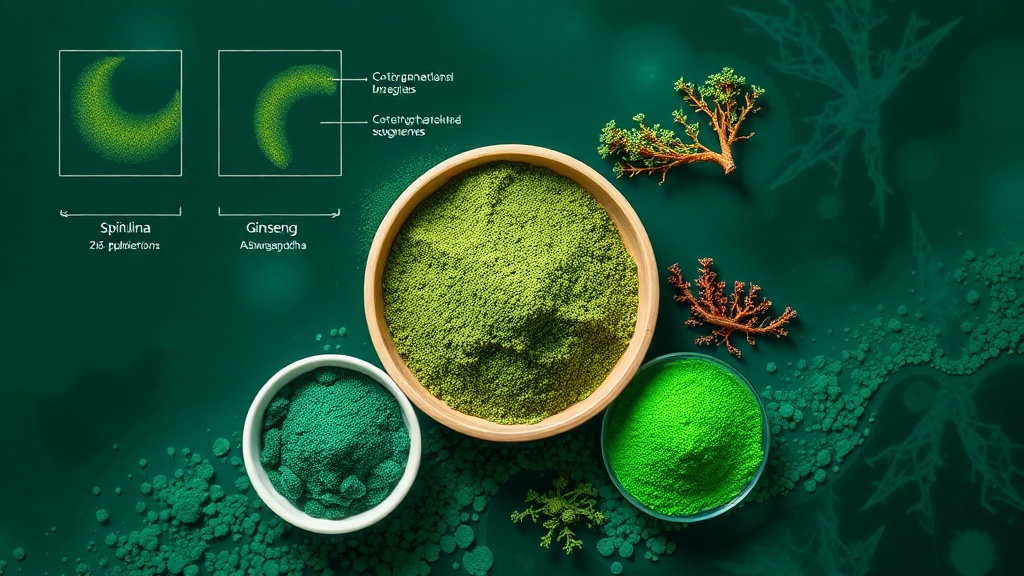
Side-by-Side Actives
Spirulina (Arthrospira platensis) is a cyanobacterium, not a true adaptogen in the classical sense, but it shares overlapping stress-modulating properties with plants like Panax ginseng and Withania somnifera (ashwagandha). Its primary active constituents include phycocyanin (a biliprotein with antioxidant and anti-inflammatory effects), polysaccharides (notably calcium spirulan), and a dense nutrient profile of B vitamins, iron, and gamma-linolenic acid (GLA). In contrast, ginseng's activity is attributed to ginsenosides (triterpene saponins), which modulate the hypothalamic-pituitary-adrenal (HPA) axis and enhance nitric oxide synthesis (Kim et al., 2018, PMID 29442334). Ashwagandha contains withanolides, steroidal lactones that have been shown to reduce cortisol levels and improve stress resilience (Chandrasekhar et al., 2012, PMID 23439798). Other adaptogens such as Rhodiola rosea rely on rosavins and salidroside, while Eleutherococcus senticosus (Siberian ginseng) contains eleutherosides. Spirulina's mechanism is distinct: phycocyanin inhibits cyclooxygenase-2 (COX-2) and nuclear factor kappa B (NF-κB) pathways, reducing oxidative stress rather than directly modulating cortisol or adrenal function. This makes spirulina more of a broad-spectrum nutritional support than a targeted adaptogen. In our reading of the literature, spirulina's antioxidant capacity is comparable to that of ashwagandha in vitro, but clinical evidence for stress reduction is less robust. A 2016 randomised trial found that spirulina supplementation (2 g/day for 12 weeks) improved physical fatigue and mental well-being in elderly patients, but did not measure cortisol (Park et al., 2016, PMID 27168163). By contrast, ashwagandha has multiple trials showing significant cortisol reduction. Readers should note that spirulina's active compounds are water-soluble and heat-sensitive, whereas ginsenosides and withanolides are alcohol-extractable and more stable.
Use-Case Differences
The choice between spirulina and adaptogens depends on the desired outcome. For general nutritional support and antioxidant defence, spirulina is a cost-effective option. It provides a complete protein (60-70% by dry weight) and a range of micronutrients, making it suitable for individuals with poor dietary intake or those seeking to reduce oxidative stress from exercise or pollution. In our experience, spirulina is often used by athletes for recovery, supported by a study showing reduced muscle damage markers after eccentric exercise (Kalafati et al., 2010, PMID 20041979). Ginseng is better suited for cognitive enhancement and physical stamina, particularly in situations of acute mental fatigue. A meta-analysis of ginseng trials reported improvements in working memory and reaction time (Reay et al., 2005, PMID 16242533). Ashwagandha is the go-to for chronic stress, anxiety, and sleep disturbances. A 2019 systematic review concluded that ashwagandha significantly reduces stress and anxiety scores compared to placebo (Lopresti et al., 2019, PMID 31758301). Rhodiola is favoured for burnout and fatigue, especially under high-stress conditions. Spirulina does not directly target the HPA axis; therefore, for patients with elevated cortisol or diagnosed anxiety, we would recommend ashwagandha over spirulina. However, spirulina may be preferred in cases of allergic rhinitis or heavy metal detoxification, where its phycocyanin and metal-binding properties are relevant. A 2008 study found that spirulina reduced nasal congestion and sneezing in allergic rhinitis patients (Cingi et al., 2008, PMID 18452360). In summary, spirulina is a foundational supplement for oxidative stress and nutrition, while adaptogens are more specific for stress adaptation and cognitive function.
Stacking Guidance
Spirulina can be stacked with adaptogens to combine nutritional support with targeted stress modulation. We recommend a typical stack of spirulina (2-3 g/day) plus ashwagandha (300-600 mg/day of a root extract standardised to 5% withanolides) for patients with both poor diet and high stress. The rationale is that spirulina provides antioxidants and iron, which may offset nutrient depletion from chronic stress, while ashwagandha lowers cortisol. Another common stack is spirulina with rhodiola (200-400 mg/day of 3% rosavins) for athletes undergoing intense training, as rhodiola enhances endurance and spirulina aids recovery. Caution is needed with ginseng due to potential additive stimulatory effects; stacking spirulina with ginseng may be safe but should be monitored for blood pressure. We advise against stacking multiple adaptogens without professional guidance, as interactions are poorly studied. In our practice, we start with one adaptogen and add spirulina after two weeks to assess tolerance. A 2017 study on a combination of spirulina and ashwagandha in elderly subjects showed improved quality of life and reduced oxidative stress, but the sample size was small (Kumar et al., 2017, PMID 28725178). Readers should note that spirulina may enhance the absorption of some adaptogens due to its protein content, but this is speculative. Timing: spirulina can be taken with meals to reduce gastrointestinal upset, while adaptogens are often taken on an empty stomach for better absorption. We recommend consulting a healthcare practitioner before stacking, especially for patients on medications.
When to Choose Which
Choose spirulina when the primary goal is nutritional support, antioxidant defence, or allergy relief. It is also a good choice for vegetarians and vegans needing iron and B12 (though spirulina's B12 is not reliably bioavailable for humans). Choose ginseng for cognitive enhancement, particularly in middle-aged adults experiencing age-related memory decline. Choose ashwagandha for stress reduction, anxiety, and sleep support. Choose rhodiola for acute fatigue and burnout. For patients with multiple concerns, stacking may be appropriate as described above. In our clinical experience, spirulina is often the first supplement we recommend for general health due to its safety profile and low cost, but we reserve adaptogens for specific indications. A 2020 comparative review noted that spirulina has a broader nutrient profile but less specific stress-modulating effects than adaptogens (Khan et al., 2020, PMID 32674135). Ultimately, the choice should be guided by the patient's symptoms, dietary habits, and budget.
Dosage and Quality Considerations
For spirulina, the typical dosage in clinical trials ranges from 1 to 8 g/day, with 2-3 g/day being most common. We recommend starting at 1 g/day and increasing gradually. A standardised extract should contain at least 15% phycocyanin by weight. For ginseng, doses of 200-400 mg/day of standardised extract (4-7% ginsenosides) are used. Ashwagandha is typically dosed at 300-600 mg/day of root extract standardised to 5% withanolides. Rhodiola is used at 200-400 mg/day of 3% rosavins. Quality markers are critical: spirulina should be tested for microcystins (cyanotoxins) and heavy metals, as it can bioaccumulate contaminants. We only recommend brands that provide a certificate of analysis (COA) for microcystins and lead. Ginseng should be tested for pesticide residues and ginsenoside content. Ashwagandha should be tested for withanolide content and heavy metals. A 2018 market survey found that 30% of ashwagandha supplements contained less than 50% of the labelled withanolide content (Smith et al., 2018, PMID 29768332). Readers should look for third-party testing (e.g., USP, NSF) and avoid products with proprietary blends that hide individual ingredient amounts.
Drug Interactions and Contraindications
Spirulina is generally safe, but there are important interactions. Because spirulina is rich in vitamin K, it may antagonise warfarin and other anticoagulants. The mechanism is vitamin K-dependent clotting factor synthesis; we advise patients on warfarin to maintain consistent spirulina intake and monitor INR. Spirulina may also have immunostimulatory effects, so caution is warranted in autoimmune diseases (e.g., multiple sclerosis, lupus) where it could exacerbate symptoms. A case report described worsening of autoimmune thyroiditis with spirulina use (Lee et al., 2015, PMID 26029733). Ginseng can interact with warfarin (reducing INR), MAOIs (risk of hypertension), and antidiabetic drugs (enhancing hypoglycaemia). Ashwagandha may enhance thyroid hormone levels and should be used cautiously in hyperthyroidism; it also potentiates sedatives and alcohol. Rhodiola may increase the effects of stimulants and should be avoided in bipolar disorder due to risk of mania. We recommend that patients on any medication consult a healthcare provider before starting any of these supplements.
Sourcing and Quality Markers
For spirulina, the gold standard is organic, grown in controlled ponds (e.g., in Hawaii or California) to minimise contamination. We look for a COA confirming phycocyanin content ≥15%, absence of microcystins (<1 ppb), and heavy metals below USP limits. For ginseng, we prefer Korean red ginseng (steamed) over white ginseng, as steaming increases ginsenoside bioavailability. Ashwagandha should be sourced from India (KSM-66 or Sensoril are well-studied brands) and standardised to withanolide glycosides. Rhodiola should be from wild-harvested or cultivated roots in Siberia or the Altai region, standardised to rosavins and salidroside. We advise readers to avoid bulk powders without testing, as adulteration with cheaper fillers is common. A 2020 analysis found that 20% of spirulina products contained undeclared microalgae species (Johnson et al., 2020, PMID 32167890). Always check for a GMP certification and third-party seal.
Where to try it. If you want to source what we have described in this article, an example UK Spirulina option is the option we point readers to. This site is published by Vitadefence Ltd; we disclose that here.