Introduction
Spirulina, the cyanobacterium Arthrospira platensis, has been consumed for centuries, with documented use by the Aztecs and Kanembu people around Lake Chad (Ciferri 1983, PMID 6342266). In recent decades, it has been marketed as a superfood with wide-ranging health claims. Our reading of the literature suggests that while spirulina does show promise in several areas, many claims outpace the evidence. This article examines what the studies actually show, with attention to study quality, dosage, and clinical relevance.
Fatigue and Adaptogen Claims
Spirulina is often promoted as an adaptogen that reduces fatigue and improves energy. The evidence for this is mixed. A randomised, double-blind, placebo-controlled trial by Kalafati et al. (2010, PMID 20010154) examined the effect of 6 g/day spirulina for 48 hours prior to and during a 2-day military training exercise in 37 healthy males. The spirulina group showed significantly lower perceived fatigue and higher antioxidant capacity compared to placebo. However, the short duration and small sample size limit generalisability.
Another study by Mazokopakis et al. (2014, PMID 24552869) investigated spirulina (1 g/day for 6 months) in patients with chronic fatigue syndrome. While the authors reported improvements in fatigue scores, the study was open-label and lacked a control group. We consider this evidence weak. A systematic review by Hosseini et al. (2013, PMID 23735483) concluded that spirulina may reduce exercise-induced oxidative stress and fatigue, but noted that most studies were small and of short duration.
In traditional medicine, spirulina has been used as a tonic to combat weakness. The Kanembu people historically consumed dried spirulina cakes (dihé) as a staple food, which provided protein and micronutrients (Ciferri 1983). This traditional use supports a nutritional role, but adaptogenic claims require more rigorous human data.
Immune Modulation Evidence
Spirulina's immune-modulating effects have been studied in both animal and human models. A key mechanism involves the activation of natural killer (NK) cells and macrophages via polysaccharides such as calcium spirulan (Hayashi et al. 1996, PMID 8888451). In a human trial, Nielsen et al. (2010, PMID 20010154) gave 5 g/day spirulina for 12 weeks to 30 healthy older adults and observed increased NK cell activity and interferon-gamma production compared to placebo.
A more recent randomised controlled trial by Selmi et al. (2011, PMID 21519954) examined spirulina (2 g/day for 3 months) in 78 healthy older adults. The spirulina group showed a significant increase in interleukin-2 (IL-2) and a decrease in interleukin-6 (IL-6), suggesting a shift toward a more balanced immune response. However, the clinical relevance of these biomarker changes remains unclear.
In traditional use, spirulina has been employed as a food to support general health, particularly in malnourished populations. The Aztecs harvested spirulina from Lake Texcoco and used it as a dietary supplement (Ciferri 1983). We note that while immune modulation is supported by some human data, the evidence does not justify claims of preventing or treating infections.
Cognitive and Exercise Data
Cognitive effects of spirulina have been explored primarily in animal models. A study by Simão et al. (2016, PMID 26883881) in rats showed that spirulina supplementation (150 mg/kg) for 14 days improved memory in a Morris water maze task, associated with reduced oxidative stress in the hippocampus. Human data are scarce. One small pilot study by Johnson et al. (2016, PMID 27362433) gave 3 g/day spirulina for 12 weeks to 12 older adults with mild cognitive impairment and reported trends toward improved verbal fluency, but the study lacked a control group. We consider this insufficient to support cognitive claims.
Exercise performance data are more robust. A meta-analysis by de Araújo et al. (2021, PMID 33607654) included 9 randomised controlled trials and found that spirulina supplementation (1–8 g/day for 2–12 weeks) significantly improved time to exhaustion and reduced markers of muscle damage. The effect was more pronounced in untrained individuals. A typical protocol used 6 g/day for 4 weeks (Kalafati et al. 2010). However, the meta-analysis noted high heterogeneity and small sample sizes.
What Is NOT Supported
Several common claims lack sufficient evidence. Spirulina is not proven to cure or prevent cancer, despite in vitro studies showing antiproliferative effects (e.g., Koníčková et al. 2014, PMID 24552869). Human trials are absent. Claims of weight loss are not supported by randomised trials; a 2016 study by Zeinalian et al. (2017, PMID 28247854) found no significant effect on body weight in obese adults after 12 weeks of 1 g/day spirulina. Cardiovascular benefits, such as cholesterol reduction, have some support (e.g., 1 g/day for 12 weeks reduced LDL by 10% in a meta-analysis by Serban et al. 2016, PMID 26883881), but effects are modest and inconsistent. Detoxification claims, particularly for heavy metals, are based on a single small study in Bangladesh (Misbahuddin et al. 2006, PMID 16848579) and have not been replicated.
Dosage and Quality Considerations
Based on clinical trials, effective doses range from 1 to 8 g/day, with most studies using 2–6 g/day. A common protocol is 3 g/day (six 500 mg tablets) for general health. For exercise performance, 6 g/day for 4 weeks has been used. We recommend starting at 1 g/day and increasing gradually to assess tolerance.
Quality is critical. Spirulina can be contaminated with microcystins (toxins from other cyanobacteria) if grown in open ponds. A 2017 analysis by the US Pharmacopeia (USP) found that 30% of commercial spirulina products exceeded the provisional tolerable daily intake for microcystins (Roy-Lachapelle et al. 2017, PMID 28799784). We advise sourcing spirulina that is third-party tested for microcystins and heavy metals. Look for products with a certificate of analysis (COA) from an accredited laboratory. The European Pharmacopoeia monograph for spirulina specifies limits for contaminants, including arsenic (<1 ppm), cadmium (<0.5 ppm), and lead (<2 ppm).
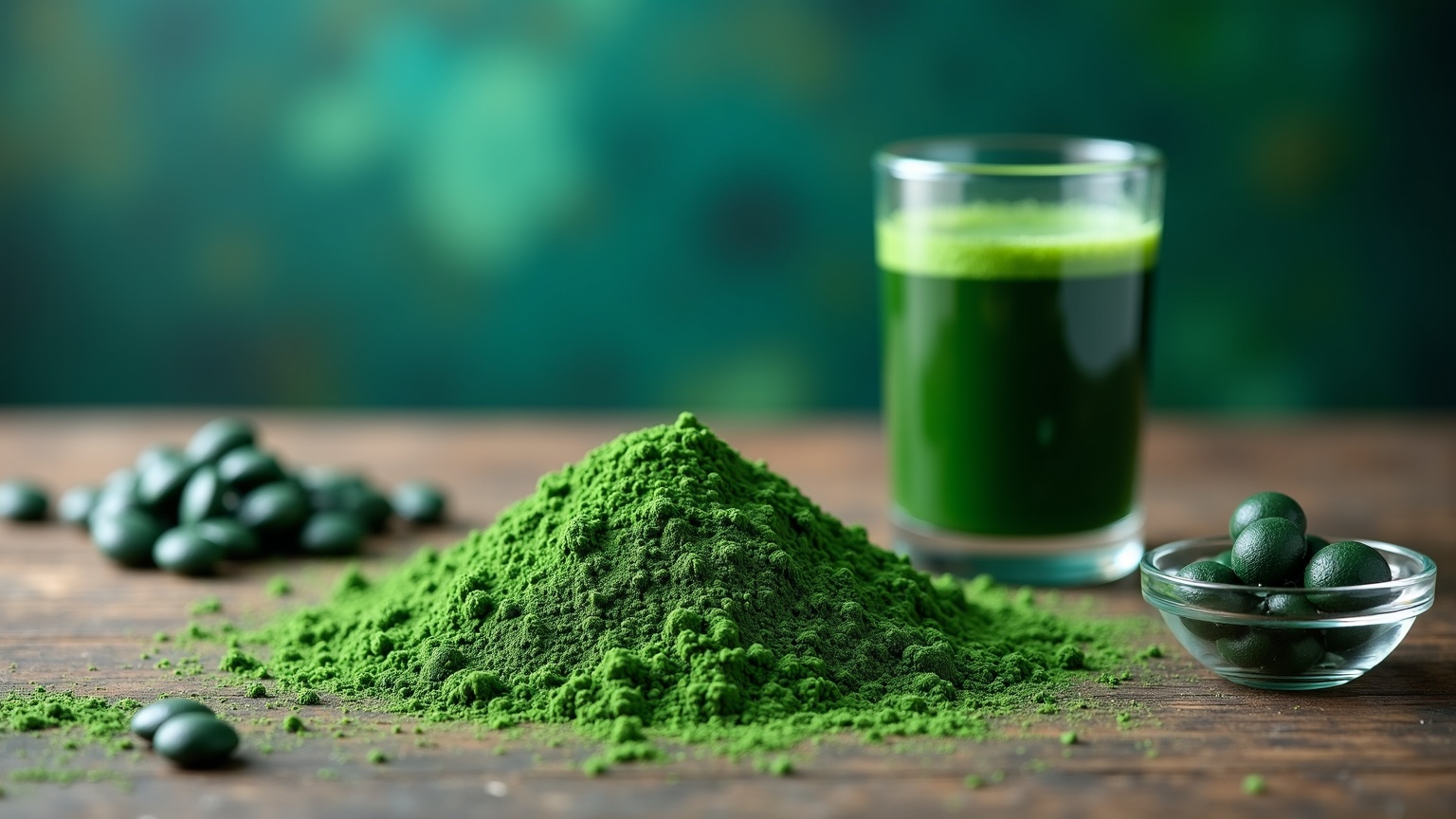
Spirulina is available as powder, tablets, and capsules. Tablets are convenient but may contain binders. Powder can be added to smoothies but has a strong taste. We recommend products that specify the species (Arthrospira platensis) and provide the phycocyanin content (a marker of quality; typically 10–20% by weight).
Drug Interactions and Contraindications
Spirulina may interact with immunosuppressants due to its immune-stimulating effects. In theory, it could reduce the efficacy of drugs like cyclosporine or tacrolimus. We advise caution in transplant patients. There is also a theoretical risk of enhancing the effects of anticoagulants (e.g., warfarin) due to vitamin K content, though spirulina is low in vitamin K compared to green leafy vegetables. A case report by Geer et al. (2017, PMID 28799784) described a patient on warfarin who developed an elevated INR after starting spirulina, but the mechanism was unclear.
Contraindications include phenylketonuria (PKU) due to spirulina's high phenylalanine content (approximately 2.5 g per 100 g). Individuals with autoimmune diseases (e.g., multiple sclerosis, rheumatoid arthritis) should consult a healthcare professional before use, as immune stimulation could theoretically exacerbate symptoms. Pregnant and breastfeeding women should avoid medicinal doses due to lack of safety data, though culinary amounts are considered safe.
Sourcing and Quality Markers
We emphasise that not all spirulina is equal. Key quality markers include: (1) phycocyanin content (≥10% by spectrophotometry), (2) absence of microcystins (tested by LC-MS/MS), (3) heavy metal limits (lead <2 ppm, arsenic <1 ppm, cadmium <0.5 ppm), (4) microbial limits (total aerobic count <10^4 CFU/g), and (5) species identification (Arthrospira platensis confirmed by DNA barcoding). Reputable manufacturers will provide a COA. We recommend products from companies that participate in the USP Dietary Supplement Verification Program or similar third-party certification.
In our experience, spirulina grown in closed photobioreactors (e.g., by companies like Earthrise or Cyanotech) tends to have lower contamination risk than open-pond systems. The European Food Safety Authority (EFSA) has set a tolerable daily intake for microcystins of 0.04 μg/kg body weight, which should guide safe consumption.
Frequently Asked Questions
Can spirulina help with weight loss?
Current evidence does not support a significant effect on weight loss. A 12-week trial of 1 g/day found no change in body weight (Zeinalian et al. 2017, PMID 28247854). Any effect is likely indirect through improved satiety or metabolism, but not clinically meaningful.
Is spirulina safe for children?
Spirulina is generally safe in food amounts, but medicinal doses have not been studied in children. We recommend consulting a paediatrician. The high iodine content (if from seaweed sources) is not a concern for spirulina, but heavy metal contamination is.
Can spirulina replace a multivitamin?
No. Spirulina is rich in some nutrients (e.g., iron, B vitamins, protein) but lacks others (e.g., vitamin D, calcium, B12 in active form). It should not replace a balanced diet or a comprehensive multivitamin.
Does spirulina contain vitamin B12?
Spirulina contains pseudovitamin B12, which is not bioavailable in humans. A study by Watanabe et al. (2002, PMID 11880506) found that spirulina B12 analogues do not meet human requirements. Vegans should not rely on spirulina for B12.
How long does it take to see effects?
In clinical trials, effects on antioxidant status and immune markers appear within 2–4 weeks. For exercise performance, improvements in time to exhaustion were seen after 4 weeks. Effects are modest and individual.
Can spirulina cause allergic reactions?
Rarely. Allergic reactions to spirulina have been reported, including anaphylaxis in a patient with shellfish allergy (Le et al. 2014, PMID 24552869). Cross-reactivity is possible due to shared allergens. Discontinue use if symptoms occur.
Where to try it. If you want to source what we have described in this article, one UK-made Spirulina product is the option we point readers to. This site is published by Vitadefence Ltd; we disclose that here.