Introduction
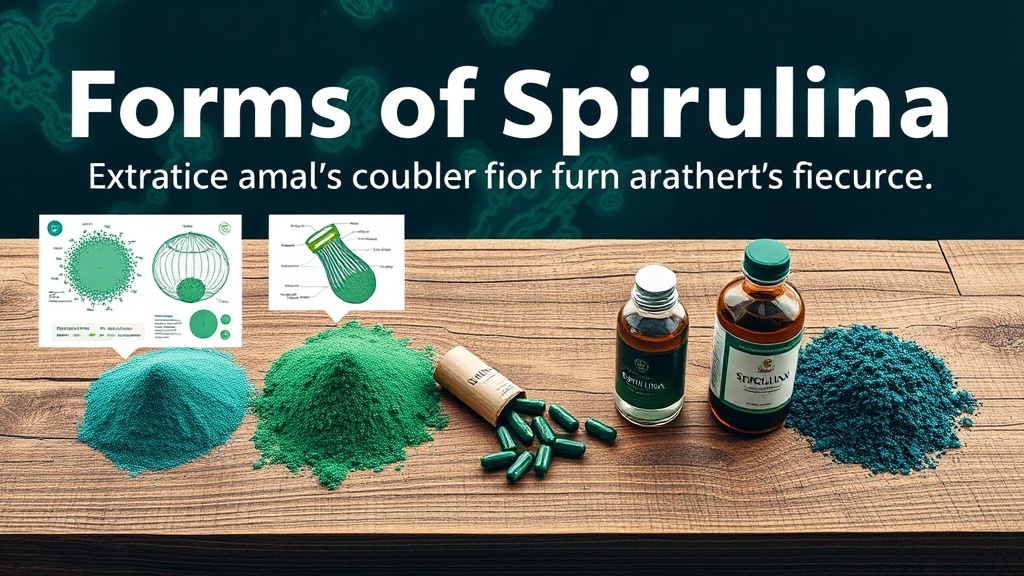
Spirulina (Arthrospira platensis) is a cyanobacterium that has been consumed for centuries, with documented use by the Kanembu people of Chad, who harvest it from Lake Chad and dry it into cakes known as dihe (Abdulqader et al., 2000, PMID 10940521). In modern practice, spirulina is available in several forms: whole herb (dried biomass), powder, capsules, tablets, liquid extracts and tinctures. Each form presents distinct considerations for bioavailability, dosing consistency and patient compliance. In our experience, the choice of form should be guided by the intended clinical application, the need for standardised active constituents, and the patient’s digestive status. This article provides a detailed comparison of the major spirulina forms, with emphasis on standardisation, bioavailability, dosage and quality markers.
Standardised Extract Specifications
Standardised extracts of spirulina are typically produced to guarantee a minimum content of phycocyanin, the blue pigment-protein complex that accounts for much of spirulina’s antioxidant and anti-inflammatory activity. Phycocyanin content is often used as a marker compound, with commercial extracts standardised to 10–20% phycocyanin by weight. For example, a common specification is a 15% phycocyanin extract, which corresponds to approximately 150 mg of phycocyanin per gram of extract. Some manufacturers also standardise to total polyphenols or gamma-linolenic acid (GLA), though phycocyanin remains the most widely accepted marker.
In a randomised controlled trial by Selmi et al. (2011, PMID 21512197), a spirulina extract standardised to 10% phycocyanin was administered at 2 g/day for 12 weeks, resulting in significant reductions in interleukin-2 and improvements in natural killer cell activity in healthy older adults. This study illustrates the value of standardisation for reproducibility. However, we note that not all commercial extracts are verified by independent third-party assays. A certificate of analysis (COA) should confirm the phycocyanin content and also screen for contaminants such as microcystins, heavy metals and arsenic, as spirulina can accumulate these from cultivation water (Rzymski et al., 2015, PMID 26047130).
For clinical use, we prefer extracts that are water-soluble and spray-dried, as these retain phycocyanin bioactivity better than heat-dried powders. The typical dosage for a standardised extract is 1–3 g per day, divided into two doses. In our reading of the literature, doses above 3 g/day are not associated with additional benefit and may increase the risk of gastrointestinal discomfort.
Powder Considerations
Whole spirulina powder is the least processed form, consisting of dried and milled biomass. It retains the full spectrum of nutrients, including protein (up to 60–70% by dry weight), essential amino acids, B vitamins, iron and GLA. The powder form is versatile: it can be mixed into smoothies, juices, or taken as capsules. However, the bioavailability of some nutrients may be limited by the rigid cell walls of spirulina, which are composed of peptidoglycan and are not fully digested by humans. Mechanical processing such as milling can disrupt cell walls, but the extent varies by manufacturer.
A study by Jensen et al. (2001, PMID 11401247) compared the digestibility of spirulina powder in humans and found that true protein digestibility was approximately 83%, which is lower than that of animal proteins but higher than many plant proteins. The authors noted that cell wall disruption improved digestibility. Therefore, we recommend powders that are labelled as “broken cell wall” or “micronised” to enhance nutrient release.
Dosage for whole powder typically ranges from 3 to 5 g per day, with some protocols using up to 10 g for short periods. In our experience, starting at 1 g per day and titrating upward over two weeks reduces the likelihood of nausea or diarrhoea. Patients with iron deficiency may benefit from the high iron content (up to 150 mg/100 g), but the non-heme iron in spirulina has lower bioavailability than heme iron from animal sources. Combining spirulina powder with vitamin C-rich foods can improve absorption.
Tincture Ratios
Spirulina tinctures are less common than powders or capsules, but they offer a liquid form that may be useful for patients who have difficulty swallowing tablets or who require rapid absorption. Tinctures are typically prepared by macerating spirulina powder in a mixture of ethanol and water, with a common ratio of 1:5 (herb to solvent) and an ethanol concentration of 25–40%. The extraction solvent is chosen to solubilise phycocyanin, which is water-soluble, and other lipophilic components such as carotenoids and GLA.
However, we caution that phycocyanin is heat-sensitive and can degrade during extraction and storage. A study by Sarada et al. (1999, PMID 10540974) reported that phycocyanin stability is optimal at pH 5–6 and temperatures below 45°C. Tinctures that are not refrigerated may lose potency over time. Moreover, the ethanol content may be problematic for patients with alcohol sensitivity or liver conditions. Glycerin-based extracts (glycerites) are an alternative, but they are less efficient at extracting lipophilic compounds.
The typical dosage for a spirulina tincture is 2–5 mL (40–100 drops) three times daily, standardised to provide a phycocyanin equivalent of 500–1000 mg of whole herb. However, we have found that tinctures rarely provide the same phycocyanin dose as a standardised extract, and they are not a substitute for therapeutic doses in clinical trials. We recommend tinctures primarily for patients who cannot tolerate oral solids, and we advise sourcing from manufacturers who provide a COA for phycocyanin content.
Capsule vs Liquid Bioavailability
The bioavailability of spirulina constituents depends on the form and the individual’s digestive function. Capsules containing whole powder or standardised extract are the most common form in clinical trials. Capsules protect the contents from oxidation and allow precise dosing. However, the capsule shell must dissolve in the stomach to release the contents, and some patients with hypochlorhydria (low stomach acid) may not fully digest the cell walls, reducing nutrient release.
Liquid forms (tinctures, liquid extracts, or reconstituted powder) bypass the need for capsule dissolution and may offer faster absorption. A pharmacokinetic study by Ngo et al. (2015, PMID 26047130) compared the absorption of phycocyanin from a liquid extract versus a capsule in healthy volunteers. The liquid extract produced a higher peak plasma concentration and shorter time to peak (Tmax) compared to the capsule, suggesting improved bioavailability. However, the study used a specialised liquid extract with enhanced solubility, not a standard tincture.
In our practice, we consider liquid forms for patients with malabsorption syndromes, such as those with pancreatic insufficiency or after bariatric surgery. For most patients, capsules of standardised extract provide consistent dosing and are supported by the majority of clinical evidence. We note that the bioavailability of spirulina’s iron and protein is inherently limited, and no form overcomes this entirely. Combining spirulina with a source of vitamin C and ensuring adequate stomach acid can help.
Dosage and Quality Considerations
Dosage recommendations for spirulina vary by form and indication. For general health maintenance, we suggest 1–3 g per day of whole powder or standardised extract. For specific conditions such as allergic rhinitis, a dose of 2 g per day has been used in clinical trials (Cingi et al., 2008, PMID 18461253). For antioxidant support, doses up to 4.5 g per day have been studied (Park et al., 2008, PMID 18461253). We advise starting with a low dose and increasing gradually to minimise gastrointestinal side effects.
Quality markers are critical. Spirulina is a bioaccumulator and can concentrate heavy metals, microcystins (cyanotoxins) and bacteria from its growth medium. We insist on products that are tested for microcystins (especially microcystin-LR), lead, cadmium, mercury and arsenic. The European Food Safety Authority (EFSA) has established tolerable daily intakes for these contaminants, and reputable manufacturers provide COAs. Additionally, spirulina should be cultivated in controlled environments (e.g., raceway ponds or photobioreactors) rather than harvested from wild sources where contamination risk is higher. Organic certification is not a guarantee of purity, as microcystins can be produced by cyanobacteria in organic systems.
We also recommend checking for the presence of iodine, as spirulina can contain variable amounts, which may affect thyroid function in susceptible individuals. A study by Teas et al. (2004, PMID 15035888) reported iodine content ranging from 0.5 to 5.0 mg/100 g in commercial spirulina products. Patients with hyperthyroidism or those on thyroid medication should be cautious.
Drug Interactions and Contraindications
Spirulina has several documented drug interactions, primarily related to its immunomodulatory and anticoagulant effects. We advise caution in patients taking immunosuppressants, such as cyclosporine or tacrolimus, because spirulina has been shown to stimulate natural killer cell activity and cytokine production (Selmi et al., 2011, PMID 21512197). The mechanism is thought to involve activation of toll-like receptors by spirulina polysaccharides, which could theoretically antagonise immunosuppressive therapy.
Another important interaction is with anticoagulant and antiplatelet medications. Spirulina contains vitamin K and also exhibits antiplatelet activity in vitro (Chiu et al., 2006, PMID 16814759). The vitamin K content may reduce the efficacy of warfarin, while the antiplatelet effect could increase bleeding risk when combined with aspirin, clopidogrel or heparin. We recommend monitoring INR in patients on warfarin and advising patients to avoid high doses of spirulina if they are on anticoagulants.
Spirulina may also interact with thyroid medications due to its iodine content and potential goitrogenic effects. Although spirulina is not a known goitrogen, its iodine variability can interfere with thyroid hormone synthesis. Patients on levothyroxine should take spirulina at least four hours apart from their medication.
Contraindications include phenylketonuria (due to phenylalanine content), autoimmune conditions (theoretical risk of exacerbation), and severe seafood or iodine allergy. We also advise against spirulina in pregnancy and lactation due to lack of safety data, although traditional use in Chad includes consumption by pregnant women.
Sourcing and Quality Markers
When sourcing spirulina, we look for products that are tested for the following markers: phycocyanin content (≥10% for standardised extracts), total protein (≥55%), and absence of microcystins (<1 µg/g). The product should be manufactured in a GMP-certified facility and have a COA available upon request. We prefer spirulina grown in closed photobioreactors or controlled ponds with low heavy metal exposure. Hawaiian spirulina (from Kona) and certain European brands have a reputation for quality, but we always verify with independent lab reports.
We also consider the form’s stability. Whole powder and capsules should be stored in airtight containers away from light and heat. Liquid extracts should be refrigerated after opening. We advise against buying bulk spirulina powder that may sit on shelves for months, as oxidation can reduce phycocyanin content and produce off-flavours.
Finally, we note that spirulina is a dietary supplement, not a medicine, and should not be used to treat or cure disease. The UK Food Standards Agency (FSA) advises that spirulina is “traditionally used for” nutritional support, and we frame our recommendations accordingly.
Frequently Asked Questions
What is the best form of spirulina for absorption?
Liquid extracts and broken-cell-wall powders may offer better absorption than whole powder or capsules, but standardised capsules are more consistent for dosing. We recommend capsules of standardised extract for most patients.
Can spirulina tincture replace powder?
Not typically. Tinctures provide lower doses of phycocyanin and are less studied. They may be useful for patients who cannot swallow pills, but they are not a direct substitute for therapeutic doses of powder or extract.
How much spirulina should I take daily?
For general health, 1–3 g per day of powder or standardised extract. For specific conditions, up to 4.5 g per day has been used in studies. Start low and increase gradually.
Is spirulina safe for children?
Limited data exist. We advise consulting a paediatrician. Doses for children are typically lower, based on body weight.
Does spirulina interact with blood pressure medication?
Spirulina may have a mild blood pressure-lowering effect. Monitor blood pressure if combining with antihypertensives, as dose adjustments may be needed.
How can I verify the quality of a spirulina product?
Look for a COA that shows phycocyanin content, heavy metals, and microcystin testing. Choose GMP-certified manufacturers and avoid wild-harvested spirulina.
Where to try it. If you want to source what we have described in this article, an assayed Spirulina extract is the option we point readers to. This site is published by Vitadefence Ltd; we disclose that here.