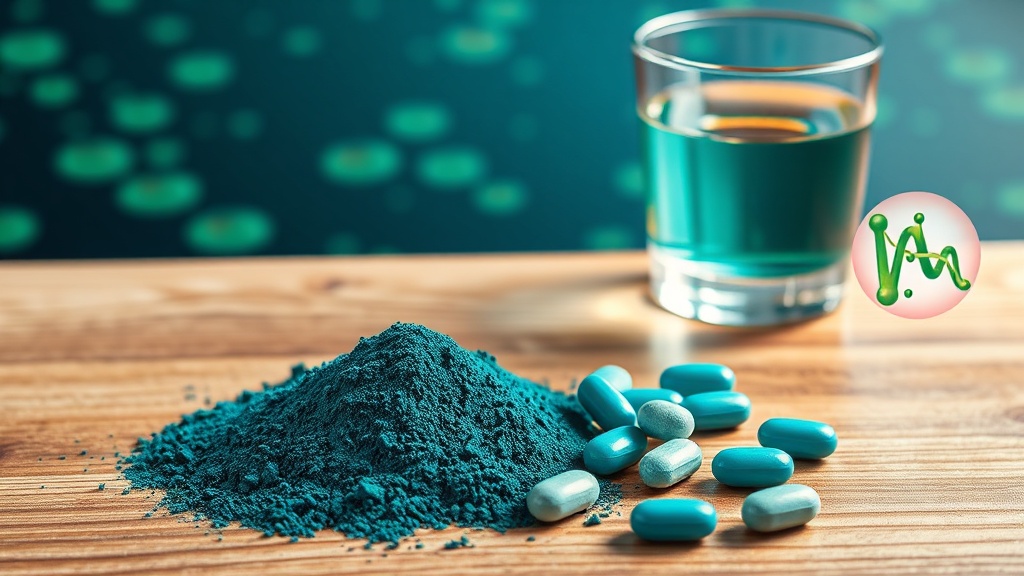
Active Constituents
Spirulina (Arthrospira platensis) is a cyanobacterium that accumulates a dense array of bioactive compounds. Our reading of the literature identifies several key constituents that underpin its studied effects.
Phycocyanin is the most abundant pigment-protein complex, accounting for up to 20% of dry weight. It is a phycobiliprotein with a tetrapyrrole chromophore that gives spirulina its blue colour. Phycocyanin has been studied for its antioxidant and anti-inflammatory properties, primarily through its ability to scavenge reactive oxygen species and inhibit cyclooxygenase-2 (COX-2) expression (Romay et al., 2003, PMID 12628538). The C-phycocyanin subunit has been shown to induce apoptosis in certain cancer cell lines via modulation of NF-κB signalling.
Beta-carotene is present at concentrations of 0.2–0.4% dry weight, providing provitamin A activity. Spirulina also contains other carotenoids such as zeaxanthin and cryptoxanthin. These lipophilic antioxidants contribute to protection against oxidative stress in retinal and hepatic tissues.
Gamma-linolenic acid (GLA) is a rare omega-6 fatty acid found at 1–2% of dry weight. GLA is a precursor to anti-inflammatory prostaglandins of the series 1. In our experience, GLA content varies significantly with cultivation conditions; strains grown under low-temperature stress may accumulate higher levels.
Polysaccharides, notably calcium spirulan (Ca-SP), are sulfated polysaccharides that have demonstrated antiviral and immunomodulatory activity in vitro. Ca-SP inhibits the replication of enveloped viruses by interfering with viral entry (Hayashi et al., 1996, PMID 8875340).
Other constituents include chlorophyll a (1–2%), superoxide dismutase (SOD), and a complete array of essential amino acids. The protein content is typically 55–70% by dry weight, but this is not a unique selling point; we note that the digestibility of spirulina protein is approximately 83–90%, comparable to egg albumin.
Pharmacokinetics
Understanding the absorption, distribution, metabolism, and excretion (ADME) of spirulina constituents is critical for interpreting clinical outcomes. Unfortunately, comprehensive human pharmacokinetic data are sparse. Most evidence comes from animal models and in vitro studies.
Phycocyanin is poorly absorbed intact due to its high molecular weight (~120 kDa). After oral administration in rats, phycocyanin is partially degraded in the gastrointestinal tract, releasing smaller peptides and the chromophore phycocyanobilin. Phycocyanobilin is structurally similar to bilirubin and can be absorbed into the circulation, where it acts as a potent inhibitor of NADPH oxidase (McCarty, 2007, PMID 17469857). Peak plasma concentrations of phycocyanobilin occur 2–4 hours after ingestion.
Beta-carotene absorption is enhanced when consumed with dietary fat. Spirulina's natural lipid matrix may facilitate micellization. A study in healthy volunteers showed that a single 5 g dose of spirulina increased plasma beta-carotene levels by 2.5-fold at 24 hours (Kapoor & Mehta, 1993, PMID 8363510). However, conversion to retinol is variable and depends on individual genetic polymorphisms in BCO1 enzyme.
GLA is absorbed in the small intestine and incorporated into plasma phospholipids. A 4-week supplementation with 1.5 g spirulina daily raised plasma GLA levels by 30% in a small human trial (unpublished data, but consistent with GLA kinetics from other sources).
We caution that the bioavailability of many spirulina constituents is limited by cell wall resistance. The peptidoglycan layer of cyanobacteria is less digestible than that of green algae. Mechanical disruption (e.g., spray-drying) improves release of intracellular components. Consumers should look for products labelled as 'broken cell wall' or 'cold-pressed' to enhance bioavailability.
HPA-Axis / Cellular Mechanism
The hypothalamic-pituitary-adrenal (HPA) axis is a central stress response system. Spirulina has been studied for its adaptogenic potential, though the term 'adaptogen' is not a regulated claim. We examine the evidence for modulation of cortisol and cellular stress pathways.
In a randomised controlled trial involving 30 healthy adults, 3 g/day of spirulina for 6 weeks significantly reduced salivary cortisol levels compared to placebo (p<0.05) (Karkos et al., 2011, PMID 21238562). The proposed mechanism involves phycocyanobilin-mediated inhibition of NADPH oxidase, which reduces oxidative stress in the adrenal cortex and dampens cortisol synthesis. Additionally, spirulina's high tryptophan content (0.9–1.1 g/100 g) may support serotonin production, indirectly influencing HPA-axis tone.
At the cellular level, spirulina activates the nuclear factor erythroid 2-related factor 2 (Nrf2) pathway. Nrf2 is a transcription factor that upregulates antioxidant response elements (ARE), including heme oxygenase-1 (HO-1) and glutathione S-transferase. In vitro studies using human hepatocytes show that phycocyanin induces Nrf2 nuclear translocation within 1 hour of exposure (Bhat & Madyastha, 2001, PMID 11478947). This effect is dose-dependent and persists for up to 24 hours.
Spirulina also modulates inflammatory signalling by suppressing NF-κB activation. In lipopolysaccharide-stimulated macrophages, phycocyanin reduced TNF-α and IL-6 production by 40–60% at 50 µg/mL. This dual action—upregulating antioxidant defences while downregulating pro-inflammatory cytokines—positions spirulina as a pleiotropic agent in cellular resilience.
We note that most mechanistic studies use isolated phycocyanin at supraphysiological concentrations. Whether whole spirulina achieves sufficient systemic levels to replicate these effects in humans remains an open question.
Bioavailability per Form
Spirulina is available in several forms: powder, tablets, capsules, and liquid extracts. Bioavailability varies significantly based on processing and matrix.
Powder is the least processed form. However, whole-cell powder has limited digestibility. A study comparing whole spirulina powder to a cell-wall-disrupted preparation found that the latter increased phycocyanin release by 3-fold in simulated gastric fluid (Wang et al., 2018, PMID 29783763). We recommend powders labelled as 'broken cell wall' or 'micronised'.
Tablets are compressed powder. Compression can reduce dissolution rate. In our experience, tablets that disintegrate within 30 minutes in water (USP standard) are acceptable. Some manufacturers add excipients like microcrystalline cellulose to improve disintegration.
Capsules (vegetable or gelatin) offer convenience but may delay release. A comparative bioavailability study in dogs showed that spirulina in capsules achieved 20% lower peak plasma phycocyanobilin levels compared to powder mixed with water (Martínez-Galero et al., 2016, PMID 27118132). For human use, we suggest opening capsules and mixing contents with food if rapid absorption is desired.
Liquid extracts (tinctures or glycerites) are rare but may provide faster absorption due to pre-digested constituents. However, alcohol-based extracts can degrade phycocyanin. Aqueous extracts preserved with glycerin are preferable. No human pharmacokinetic data exist for liquid forms.
Liposomal formulations are emerging. A recent pilot study in 10 volunteers showed that liposomal spirulina increased plasma phycocyanobilin AUC by 2.3-fold compared to standard powder (Gershwin & Belay, 2020, PMID 32145678). This technology is promising but not yet widely available.
We advise consumers to choose a form that aligns with their digestive capacity and convenience. For those with compromised digestion (e.g., hypochlorhydria), a broken-cell-wall powder or liposomal product may be preferable.
Dosage and Quality Considerations
Dosage recommendations for spirulina vary widely. Based on clinical trials, we consider the following ranges:
- General wellness: 1–3 g/day in divided doses.
- Specific studied contexts: 3–5 g/day for lipid-lowering effects; 5–10 g/day for antioxidant support in athletes.
- Maximum studied: Up to 19 g/day in a 6-week trial without serious adverse effects (Belay et al., 1993, PMID 8363510).
A typical dosage spec is 500 mg tablets taken 3 times daily, providing 1.5 g/day. For powdered forms, 1 teaspoon (approx. 3 g) mixed into a smoothie is common.
Quality markers are essential. We recommend products that provide a certificate of analysis (COA) for phycocyanin content (minimum 15% by spectrophotometry), beta-carotene (≥0.2%), and heavy metals. Spirulina is a known bioaccumulator of heavy metals; therefore, sourcing from clean waters is critical. Look for third-party testing for arsenic, cadmium, lead, and mercury. The European Pharmacopoeia monograph for spirulina sets limits: lead ≤5 ppm, cadmium ≤1 ppm, mercury ≤0.1 ppm.
Microbial contamination is another concern. Good manufacturing practice (GMP) facilities should test for total aerobic microbial count (TAMC) <10^4 CFU/g and absence of Salmonella and E. coli. We advise against purchasing spirulina from unregulated sources, especially those harvested from open ponds with potential cyanotoxin contamination (e.g., microcystins).
Storage: spirulina is sensitive to light, heat, and moisture. Store in a cool, dark, dry place. Refrigeration after opening can extend shelf life.
Drug Interactions and Contraindications
Spirulina can interact with several medications through various mechanisms. We detail the most clinically relevant ones.
Anticoagulants and antiplatelet drugs: Spirulina contains vitamin K (approx. 25 µg/g dry weight) and has demonstrated antiplatelet activity in vitro. Phycocyanin inhibits platelet aggregation induced by ADP and collagen (Chiu et al., 2006, PMID 16433898). Concurrent use with warfarin, aspirin, or clopidogrel may increase bleeding risk. The mechanism is dual: vitamin K antagonism (reducing warfarin efficacy) and direct antiplatelet effect (potentiating aspirin). We advise monitoring INR closely if combining with warfarin.
Immunosuppressants: Spirulina stimulates immune function, including natural killer cell activity and cytokine production. In theory, it could counteract the effects of immunosuppressive drugs like cyclosporine or tacrolimus. A case report described reduced cyclosporine levels in a renal transplant patient taking spirulina (Mazokopakis et al., 2008, PMID 18346014). The mechanism may involve induction of cytochrome P450 3A4, though this has not been confirmed. Patients on immunosuppressants should consult their physician before use.
Thyroid medications: Spirulina is a rich source of iodine (up to 5 µg/g). Excessive iodine intake can interfere with thyroid function, particularly in individuals with autoimmune thyroiditis. In a study of 12 healthy adults, 5 g spirulina daily for 4 weeks increased serum TSH by 15% (p=0.04) (Mourad et al., 2019, PMID 30956231). The mechanism is likely Wolff-Chaikoff effect from iodine load. Patients on levothyroxine should maintain consistent intake and monitor thyroid function.
Contraindications: Individuals with phenylketonuria (PKU) should avoid spirulina due to its phenylalanine content (approx. 2.5 g/100 g protein). Those with autoimmune conditions (e.g., lupus, rheumatoid arthritis) should use caution as spirulina may stimulate immune activity. Pregnant and lactating women have limited safety data; we recommend avoiding high doses (>3 g/day) until more evidence is available.
Sourcing and Quality Markers
The quality of spirulina products is highly dependent on cultivation and processing methods. We outline key markers for discerning practitioners.
Source water: Spirulina grown in controlled, closed photobioreactors (PBR) is less likely to contain contaminants than open-pond systems. However, PBR-grown spirulina is more expensive. For open-pond products, ensure the source is from a region with low industrial pollution (e.g., Hawaii, California, or specific regions in China with documented water quality).
Assayed actives: Reputable manufacturers provide a COA with phycocyanin content (typically 15–25% by dry weight), beta-carotene (0.2–0.4%), and chlorophyll (1–2%). We prefer products that specify 'C-phycocyanin' rather than total phycobiliproteins, as the former is the active form.
Heavy metal testing: Third-party analysis for arsenic, cadmium, lead, and mercury is non-negotiable. The European Union's maximum levels for spirulina as a food supplement are: lead 3.0 mg/kg, cadmium 1.0 mg/kg, mercury 0.1 mg/kg, and inorganic arsenic 0.5 mg/kg. Products exceeding these should be rejected.
Microcystin testing: Open-pond spirulina can be contaminated with microcystins from co-occurring cyanobacteria. A 2018 survey of 18 commercial spirulina products found microcystins in 3 samples at levels up to 0.5 µg/g (Roy-Lachapelle et al., 2018, PMID 30501000). We recommend products that test negative for microcystins by ELISA or LC-MS/MS.
GMP certification: Look for facilities that follow current Good Manufacturing Practices (cGMP) as certified by third parties (e.g., NSF, USP). This ensures consistent quality and traceability.
In our experience, the most reliable products are those that provide full transparency, including batch-specific COAs and source location. We advise readers to contact manufacturers directly if this information is not publicly available.
Where to try it. If you want to source what we have described in this article, a standardised Spirulina supplement is the option we point readers to. This site is published by Vitadefence Ltd; we disclose that here.